Effective Wave Height & Establishment Season
Site exposure is a key factor influencing mangrove establishment, with exposed sites experiencing stronger waves and wind which dislodge young mangroves before they can establish a strong enough root structure. Even fully grown adult mangroves can not withstand exposure on open beaches with high swell and breaking surf. Recent studies have found that the wave energy thresholds for mangrove establishment are not strongly determined by averaged wave energy, rather by periods of time with low wave energy. Essentially, the timing and periods of strong wave energy is often more important than the averaged values of wave energy.
Mangrove seedlings are most vulnerable in the first weeks to months after a propagule strands and starts to root, and can easily be dislodged by even small waves during this time. As seedlings grow, they can tolerate larger waves. A site can therefore have suitable inundation and tidal connectivity, but still be unsuitable for mangroves because waves are too frequent or too large for seedlings to survive.
This analysis follows the approach of Wells et al. (2026), which found that waves are a key key predictor global open-coast mangrove distribution when considering periods of Window of Opportunity (WOO). It produces two outputs:
- Effective wave height map — the typical wave height in metres reaching each intertidal pixel, shown on the results page and in the PDF report.
- Establishment season plot — how the chance of seedling establishment varies in each month throughout the year, shown in the PDF report.
The WOO model developed in the paper of Wells et al. was demonstrated to have an accuracy of between 75% and 86% in predicting the presence or absence of mangroves on the open coast, dependent on species. The approach applied here extends the WOO model and the thresholds determined to also factor in estimated wind waves (for sites not exposed to open ocean swell) and apply it at a per pixel level.
Effective wave height
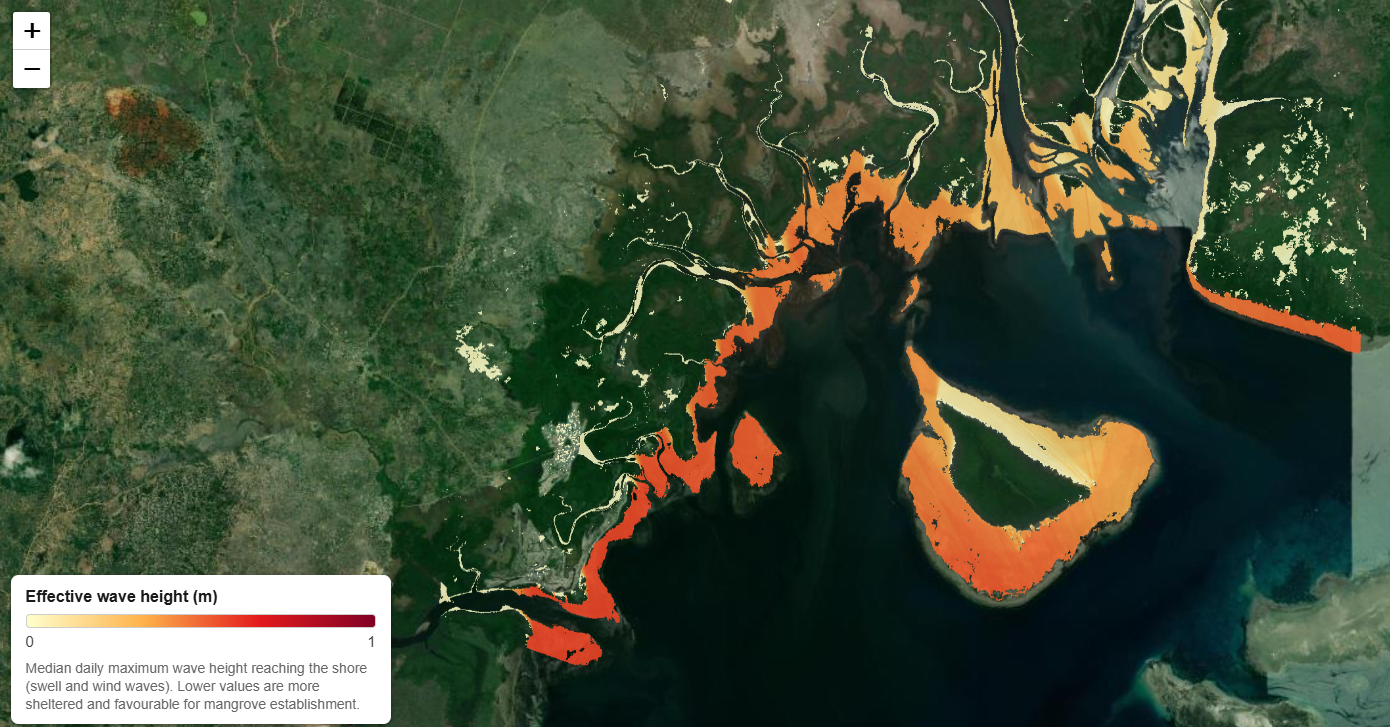
The effective wave height map shows, for each intertidal pixel, the median of the daily maximum effective wave height over the last 5 years, in metres.
- Low values (pale yellow in the web viewer) indicate sheltered areas, where waves are rarely large enough to disturb seedlings.
- High values (orange to dark red) indicate exposed areas, where waves are regularly larger than seedlings can tolerate.
For reference, the establishment thresholds used below range from about 0.07 m (the largest wave a newly stranded seedling can survive) to about 1.13 m (the largest wave a one year old seedling can survive). The image below shows an example site with EWH ranging up to 1m. Mangroves are found at all locations within this site, however much more natural recruitment is seen at the sites with lower EFH.
Windows of opportunity and the establishment season
A window of opportunity is a period after a propagule strands in which the waves stay low enough for the seedling to establish and survive. The figure below from Wells et al. (2026) illustrates the concept. Seedlings stranded just before a period of large waves are dislodged (cases 1 to 3), while a seedling stranded at the start of a calm enough period survives and becomes established (case 4).
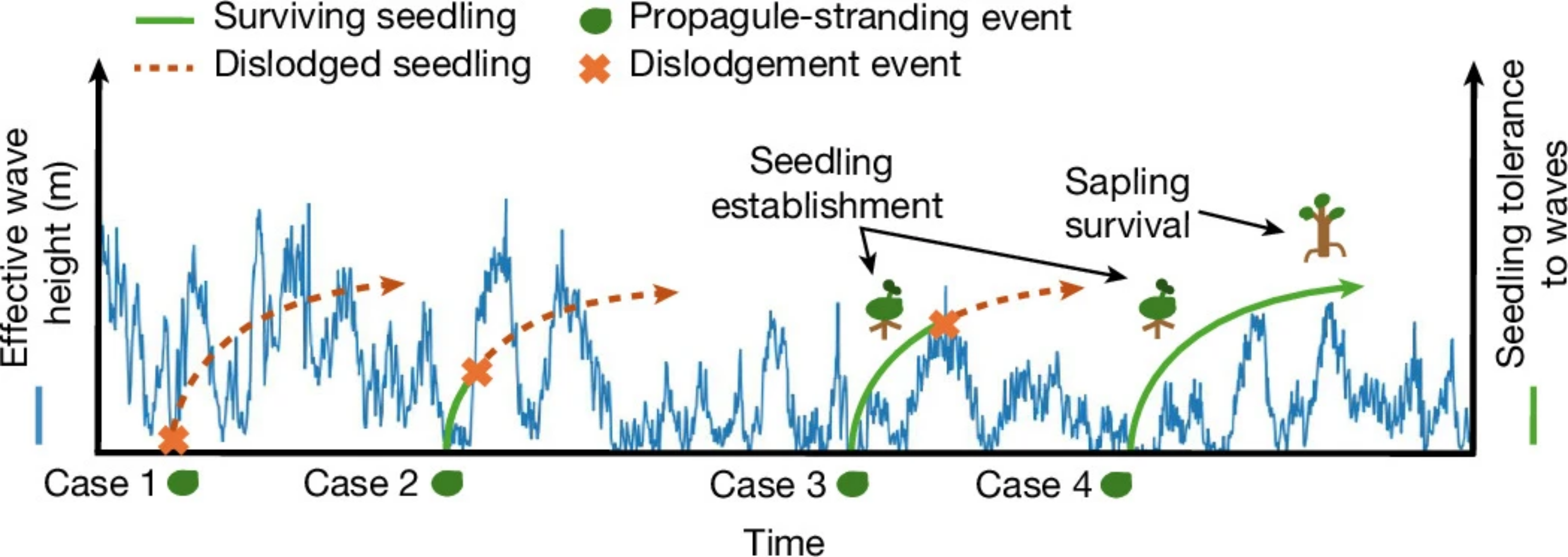 Figure from Wells et al. (2026), Nature, Fig. 1 (open access).
Every day of the wave record (except the final year) is tested as a possible stranding date for each intertidal pixel. A stranding day is successful if the effective wave height stays below the seedling's tolerance for the whole following year, with the tolerance increasing as the seedling grows.
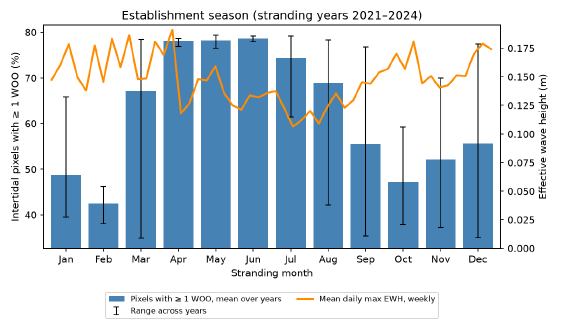
The establishment season plot in the report summarises these results by month:
- Bars show the percentage of intertidal pixels with at least one successful stranding day in that month, averaged over the years of the record. The whiskers show the range across years assessed.
- The orange line shows the weekly average of the daily maximum effective wave height across the intertidal pixels.
Months with higher bars are the most favourable times for seedling establishment, whether by natural recruitment or planting. Large differences between years (long whiskers) indicate that conditions vary a lot from year to year. An example is shown in the image below. At this site, the months of April to July show the best conditions for mangrove establishment, possibly also extending to March and August however this appears to depend on the year due to the wide range indicated by the whiskers. The orange line also shows a reduction in average effective wave height during those months, which helps to estimate the analysis validity.
Methodology
The analysis covers intertidal pixels inundated in 2% to 80% of satellite scenes (the same intertidal zone used for Tidal Connectivity). For each day of the last 5 complete calendar years, the effective wave height (EWH) of each pixel is the largest of:
- Offshore waves — the primary swell, secondary swell and wind sea from the Copernicus Marine WAVERYS global wave reanalysis, at the nearest offshore wave model cell. Offshore waves are only counted from directions where the pixel has a clear, straight line of sight to open sea (see Wind & Swell Exposure).
- Locally generated wind waves — estimated from ERA5 hourly wind at the nearest offshore grid cell and the pixel's fetch (the distance of open water upwind) in that wind direction, using the fetch-limited wave growth equations of the Coastal Engineering Manual.
A seedling stranded on a given day establishes if the maximum effective wave height stays below the threshold for every duration from 1 day to 52 weeks after stranding. The thresholds are the all-sites values from Wells et al. (2026), increasing from 0.07 m for 1 day to 1.13 m for 52 weeks.
The downloadable results also include the 90th percentile of daily maximum effective
wave height (ewh_p90.tif), the mean number of successful stranding days per year
(woo_days_per_year.tif) and the number of years with at least one successful
stranding day (woo_years.tif).
Limitations & sources of error
- Conservative wave heights. Daily maximum wave heights are used, and the effects of shallow water depth, reefs and limited wind duration on wave growth are ignored. Both would usually reduce wave heights, so effective wave heights are likely to be overestimated, particularly in shallow, sheltered areas.
- No refraction or diffraction. The analysis only models waves travelling in straight lines from the open sea. Waves bending around headlands or islands, and wave energy lost over shallow reefs or mudflats, are not modelled.
- Coarse offshore data. The wave and wind data come from a single offshore model cell (about 20 km for waves, about 30 km for wind), which may not represent local conditions in complex coastlines, enclosed bays or large estuaries. Mountainous regions in particular may have significant local effects on wind speeds not captured in the low resolution model used.
- Global thresholds. The establishment thresholds are averages across mangrove sites globally. The tolerance of local species and seedlings may differ. Avicennia and Sonneratia species for example generally have root structures better adapted for fixation at exposed sites, compared to young Rhizophora species.
- Waves only. Windows of opportunity here only consider waves. Inundation, sediment movement, propagule supply, salinity and grazing also affect whether seedlings establish. When considering natural recruitment, this is driven by local species fruiting season, which is often (but not always) in the calmer seasons.
- Mapped water level. Fetch and line of sight are estimated with the coastline at a high water level, which is conservative (more exposed) at lower tides.
References
- Wells, S. et al. (2026). Global mangrove distribution on the open coast is controlled by waves. Nature. https://doi.org/10.1038/s41586-026-11089-z
- U.S. Army Corps of Engineers (2002). Coastal Engineering Manual, Part II, Chapter 2. EM 1110-2-1100.
- Copernicus Marine Service. Global Ocean Waves Reanalysis (WAVERYS), GLOBAL_MULTIYEAR_WAV_001_032.
- Hersbach, H. et al. (2020). The ERA5 global reanalysis. Quarterly Journal of the Royal Meteorological Society, 146(730), 1999–2049.
Wave exposure and mangroves
Site exposure and waves are key factors in early mangrove survival, and fully exposed beaches with high swell are not suitable even for fully grown mangroves. Considering site exposure is a crucial step in assessing the site suitability beyond only the tidal range and connectivity. The effective wave height and establishment season help identify suitable sites, and also indicate the best time of year for planting where conditions allow it (if planting is determined to be the appropriate site intervention). Considering exposure also helps to identify sites suitable for natural recruitment.